
Buying a Car in Nigeria? Don’t Get Duped by Fake Customs & VREG Documents
Buying a Car in Nigeria? Don’t Get Duped by Fake Customs & VREG Documents
Buying a vehicle is already a major financial commitment. Whether you are buying a brand-new imported vehicle, a fairly used “tokunbo,” or a vehicle that has just arrived in Nigeria, there is one part of the process you should never take on trust alone: the vehicle documentation.
A document can look genuine, carry official-looking logos, stamps, reference numbers and signatures—and still not prove that the vehicle’s customs obligations were actually completed.
This is why every car owner and prospective car buyer should learn one simple rule:
Verify the VIN. Don’t just verify the paper.
How Can Vehicle Documentation Become a Problem?
When an agent is handling customs clearance and vehicle registration on your behalf, you may give the agent money to take care of the entire process.
The expectation is straightforward:
You pay → the agent processes the vehicle → customs duty and other required obligations are settled → you receive legitimate documentation → the vehicle can be properly registered.
But problems can arise when the process isn’t completed as expected.
For example, an agent may begin a customs process, generate an initial assessment or other transaction documentation, but the required payments may not ultimately be completed. A buyer who only sees the paperwork may assume that the vehicle has been fully cleared.
There is also a more serious risk: fraudulent or manipulated documents can be presented as evidence of clearance.
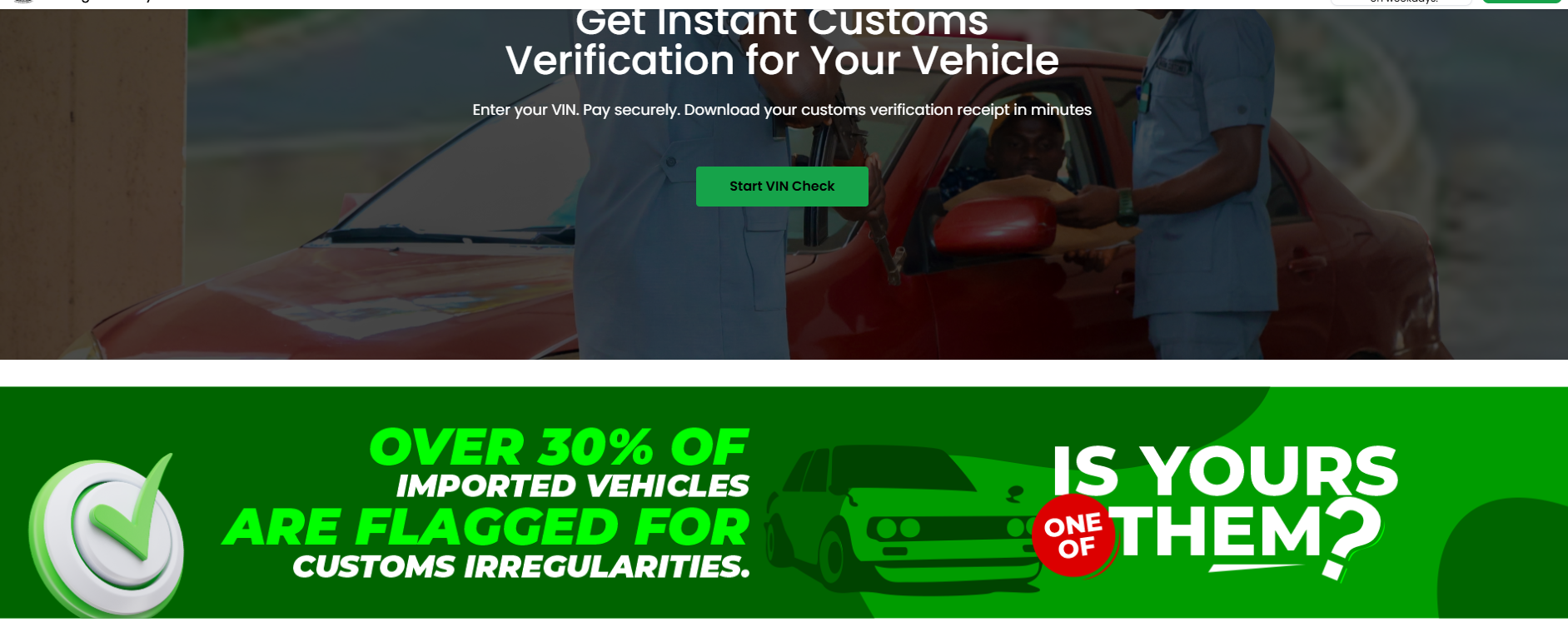
The Nigeria Customs Service has introduced the Customs Verification Management System (CVMS) specifically to allow the public to verify vehicle clearance using the vehicle’s VIN or chassis number. According to Customs’ published information, CVMS is intended to help users confirm whether import duty has been duly paid and to provide an official verification record. (Nigeria Customs Service)
So don’t let a piece of paper be your only proof.
Your VIN Is More Important Than the Paper in Your Hand
Your VIN (Vehicle Identification Number) is the vehicle’s unique identifier.
When dealing with customs clearance, registration or purchasing an imported vehicle, make sure the VIN you’re checking is the same VIN physically found on the vehicle.
Don’t simply accept:
- A VIN typed on a document
- A photograph of a customs receipt
- A WhatsApp copy of a clearance document
- An agent’s statement that “everything has been paid”
- A document containing an official-looking stamp
- A VREG number without independently verifying the vehicle
Check the VIN yourself.
Check Customs Duty Through CVMS
The Nigeria Customs Service’s Customs Verification Management System (CVMS) provides a way to verify the customs clearance status of a vehicle using its VIN/chassis number. Customs describes CVMS as a platform for confirming whether import duty has been duly paid and for generating an official customs verification receipt. (Nigeria Customs Service)
You can access the CVMS here:
Nigeria Customs Vehicle Customs Verification Management System (CVMS)
https://cvms.nigeriatradehub.gov.ng/
Before you complete a vehicle purchase:
- Get the vehicle’s VIN.
- Compare it with the VIN physically stamped/installed on the vehicle.
- Enter the VIN into the official verification platform.
- Check the customs status.
- Make sure the information returned corresponds with the vehicle you’re buying.
- Keep your verification result as part of your purchase records.
Don’t allow someone else to do the verification and only send you a screenshot.
If possible, perform the check yourself.
Then Check VREG
Customs clearance is not the only thing you should verify.
Nigeria’s Vehicle Registration System (VREG) provides vehicle verification services, including VIN verification and duty-status verification. The official VREG website states that its Duty Status service can confirm import duty and customs clearance status and identify outstanding obligations. (VREG)
You can check it here:
Or go directly to the duty verification page:
VREG allows you to enter the VIN and check the vehicle’s duty-payment status. (VREG)
Why Should You Check Both?
Think of it as two layers of protection.
Layer 1 — Customs verification
Ask:
“Was the vehicle properly cleared and was the required customs duty paid?”
Layer 2 — Vehicle registration verification
Ask:
“Does this VIN exist correctly within the vehicle registration system, and what is its registration/duty status?”
VREG specifically provides VIN registration and VIN verification functions, as well as duty-status verification. (VREG)
Don’t assume that because an agent gives you one document, everything else automatically follows.
“But I Gave the Agent the Full Money!”
This is one of the biggest reasons buyers need to verify for themselves.
If you give an agent money specifically to handle customs and registration, the fact that you paid the agent does not by itself prove that the government received the full required amount.
Your transaction with the agent and the government’s record of payment are two different things.
That’s why you should ask for evidence that can independently be verified.
For example:
Agent:
“Customs has been paid.”
You:
“Okay. Give me the VIN. I’ll verify it.”
That’s not being difficult.
That’s being a responsible vehicle owner.
Don’t Confuse “Process Started” With “Process Completed”
This is another important point.
A vehicle can have documentation showing that a process was initiated without necessarily meaning that every required stage was successfully completed.
The Nigeria Trade Portal itself provides access to customs processes and electronic documents, including Single Goods Declaration and PAAR-related services. (Trade.gov.ng)
Therefore, seeing an assessment, reference number, application or other transaction document should not automatically be treated as proof that all customs obligations have been fully settled.
The question you should be asking is:
“What is the final verified status of this VIN?”
A Fake Document Can Look Very Real
This is why relying exclusively on physical paperwork can be dangerous.
Technology has made it increasingly easy to reproduce:
- Logos
- Letterheads
- Reference numbers
- Stamps
- Signatures
- Receipts
- Screenshots
- PDF documents
A professional-looking document is not necessarily proof of a completed government transaction.
Independent verification is stronger than appearance.
Before You Buy Any Imported Vehicle, Follow This Checklist
✅ 1. Get the VIN
Don’t buy a vehicle simply because the seller says the documents are complete.
Get the VIN.
✅ 2. Match the VIN physically
Compare the VIN on:
- Vehicle
- Dashboard
- Door/vehicle identification label
- Customs documentation
- Registration documents
The VIN must correspond.
✅ 3. Verify Customs
Use the official CVMS platform to check the customs clearance/duty status.
Check Customs Vehicle Verification — CVMS
✅ 4. Verify VREG
Check the VIN through the official VREG system and review the available duty/registration information.
✅ 5. Don’t rely on screenshots
Ask to see the result, but preferably perform the verification yourself.
✅ 6. Keep evidence
Save:
- Payment receipts
- Bank transfers
- Agent invoices
- Customs documents
- VREG information
- VIN verification results
- Communication with the agent
7. Don’t rush because the seller says “another buyer is coming”
A few minutes of verification can potentially save you from a very expensive problem.
Warning Signs You Should Take Seriously
Be extremely cautious when someone tells you:
“Don’t worry, the documents are original.”
Ask:
“Can I verify the VIN?”
If the answer is:
“There’s no need.”
That’s a reason to do the verification even more carefully.
Other warning signs include:
🚩 The agent refuses to provide the VIN.
🚩 The VIN on the documents doesn’t match the vehicle.
🚩 You’re told customs has been paid but no independent verification is available.
🚩 You’re given only screenshots instead of verifiable records.
🚩 The agent becomes uncomfortable when you ask for payment evidence.
🚩 You’re pressured to pay the balance before verification.
🚩 The documentation contains inconsistencies.
🚩 The seller says, “You can verify it after you pay.”
Verify first. Pay second.
The Smartest Buyer Is an Independent Buyer
You don’t have to assume that every customs agent, car dealer or registration agent is dishonest.
There are legitimate professionals doing proper work.
But trust should not replace verification.
A good agent should have no problem with you independently verifying the vehicle’s VIN and documentation.
In fact, independent verification protects both the customer and the honest agent.
Remember These Three Words
VIN. VERIFY. BEFORE PAYMENT.
Before you spend millions of naira on a vehicle, don’t just ask:
“Does it have customs papers?”
Ask:
“Can I independently verify the customs status of this VIN?”
Then check it.
The official VREG platform also specifically promotes duty-status verification as a way to confirm whether import duty has been fully paid and whether there are outstanding obligations. (VREG)
Don’t Buy the Paper. Verify the Vehicle.
A vehicle can look perfect.
The seller can sound convincing.
The documents can look genuine.
The agent can assure you that everything is complete.
But your VIN can tell you a different story.
Before buying an imported vehicle in Nigeria—or accepting responsibility for a vehicle whose customs and registration were handled by an agent—take a few minutes to independently verify the VIN.
Check Customs:
CVMS — Nigeria Customs Vehicle Verification
Check VREG:
VREG — National Vehicle Registration System
Don’t wait until you have a problem before discovering that the vehicle’s documentation was never properly completed.
Verify first. Buy with confidence.
This article is for consumer awareness and does not replace professional or legal advice. Always use the current official government verification channels and confirm the information returned for the specific VIN.